
Our Services
Cost Segregation Studies
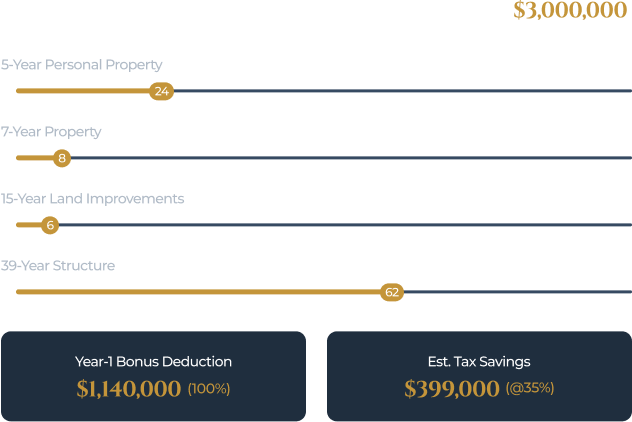
An engineering-based analysis reclassifying commercial building components from 27.5- or 39-year real property into 5-, 7-, and 15-year personal property — dramatically accelerating your depreciation timeline and improving year-one cash flow.
substantially larger deductions in years one through five, reducing your current-year tax liability without changing your actual income.
- Full engineering site inspection and blueprint analysis
- IRS-defensible, ASCSP-methodology-aligned report
- Average savings: $50,000 – $100,000 per $1M in building value
- Asset-by-asset component reclassification
- CPA-ready depreciation schedules in standard format
- Best results for properties acquired or improved since 2018
$3M Office Building
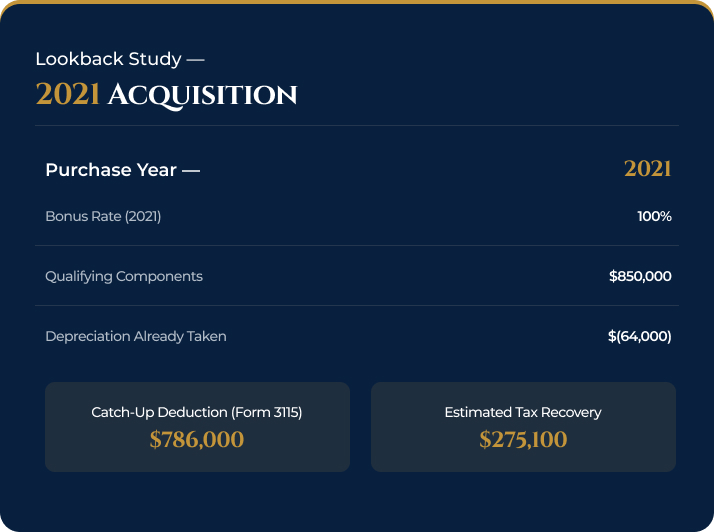
Lookback Studies — Retroactive Cost Segregation
Purchased or improved commercial property in prior years without a cost segregation study? You don’t need to amend returns. A lookback study allows you to claim a one-time catch-up deduction in the current tax year using IRS Form 3115 (Change in Accounting Method).
One of the most powerful — and most underused — tools in real estate tax strategy. Properties acquired as far back as 1987 may qualify.
- No amended returns required — claim via Form 3115
- Large catch-up deductions in the current year of filing
- Properties from 2017–2024 generate highest recoveries
- Retroactive reclassification of building components
- Particularly powerful in high-income years
- Works with applicable bonus rates for each prior year
Section 179D — Energy- Efficient Commercial Building Deduction
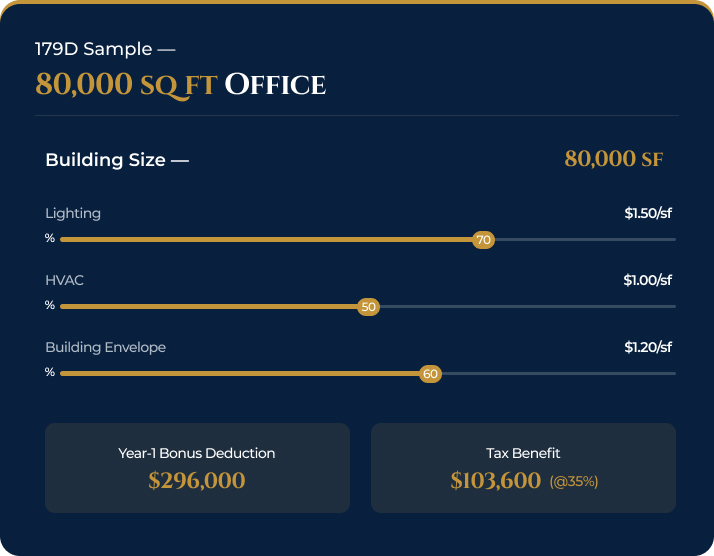
Section 179D provides a tax deduction of up to $5.00 per square foot for energy-efficient improvements to commercial buildings — including lighting, HVAC, building envelope, and insulation systems.
Government entities and nonprofits that cannot directly use the deduction can allocate it to the designer or engineer of record, creating significant additional value.
- Up to $5.00/sq ft.
- Lighting/HVAC/envelope upgrades
- Often bundled with cost seg
- New construction AND renovations
- Government/nonprofit allocation to designers
- Prevailing wage reqs for max deduction
Section 45L — Energy Efficient Home Tax Credit
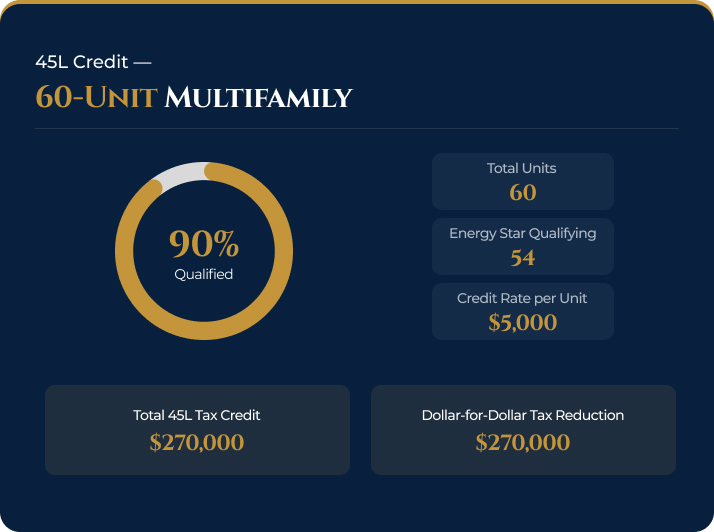
Section 45L provides a federal tax credit of up to $5,000 per unit for developers and builders of energy-efficient new residential construction and substantial renovations — including single-family, multifamily, and townhomes
- Up to $5,000/unit ENERGY STAR
- Developers/contractors/builders
- Stackable with cost seg
- Single-family, townhomes, multifamily 5+
- Dollar-for-dollar credit (not deduction)
- New construction and gut-rehab
Tangible Property Regulations (TPR) Analysis
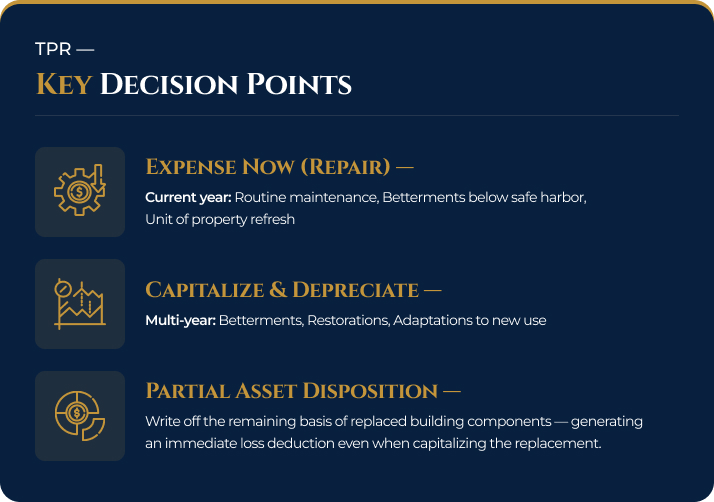
The IRS Tangible Property Regulations govern how building expenditures must be treated — as a capital improvement (depreciated over years) or a deductible repair (expensed immediately). Proper TPR analysis ensures you maximize current-year deductions on maintenance, renovation, and improvement spending.
- Repair vs. capital improvement classification
- Safe harbor elections for routine maintenance
- Often with cost seg
- Partial asset dispositions
- De minimis safe harbor for materials
- Any renovation size
Not Sure
Which Service Applies to You?
Schedule a free 30-minute consultation. We’ll review your properties and give you an honest assessment — no sales pressure.